Our Approach
How do we heal chronic pain? Through functional training in body, mind, and spirit.
We interweave biomechanics and contemplative practices for a holistic approach to healing persistent pain.
Hearing your story is the most important piece. BeyondPT does not rush clients in and out.
Although we do nerd out on biomechanics and exercise science, what we’re really passionate about is the interwoven fabric of the mind, body and everything more.
That’s why we take the time to really hear your story and continuously check in through the whole process of our work together.
Movement is Medicine
It is true that massage and similarly passive modalities can often be helpful because these provide immediate relief, however, their effects may be unreliable in longevity.
We believe that an active approach provides a slower but more reliable accumulation of long term relief and resilience. By engaging in movement, whether highly targeted and precise (as in strength training for improved biomechanics), or broad and exploratory (as in activity exposure therapy) we activate a strong neuro-adaptive response. There is magic in creating a challenge for ourselves that is only just difficult enough but entirely possible to accomplish.
Would you like a dash of biomechanics with your movement?
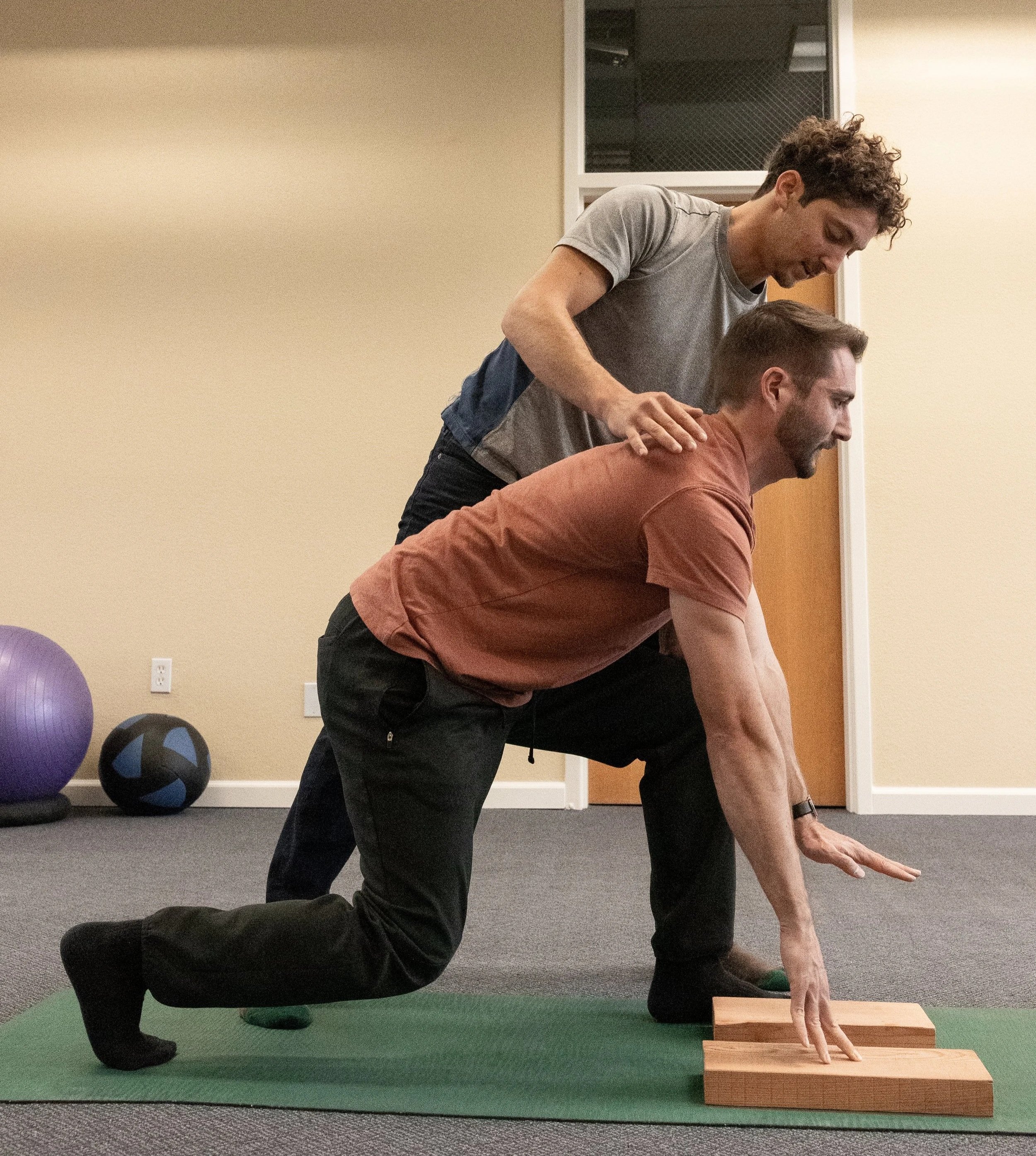
We often like to offer biomechanics-based strength training for our clients because in addition to so many other benefits, it can prevent sprains and other such injuries elsewhere in the body and improve the longevity of our athletic and active lives.
We select exercises that strengthen the gait cycle and are specific for particular sport, career, or hobby demands, as well as acute injury recovery.
Importantly, we make sure that clients are engaging optimal bracing patterns before lifting heavy weights.
Foundational to this aspect of our approach is Dynamic Neuromuscular Stabilization (DNS)—a modality developed from the study of how we each, as infants, learn to roll, crawl, walk, and squat. DNS taps into the innate motor learning systems we’ve evolved since the dawn of bipedalism to improve our motor coordination. It works both the conscious (“cortical”) and subconscious (“subcortical”) control systems. Mobility, resilience, and a rock-solid bracing pattern flourish with regular practice.
How do we leverage the mind-body connection to recover from chronic pain?
Simply put, pain = sensation + danger.
The more fully we can dissolve “danger” from our experience, the more we can do pain-free.
Our goal is to be a resource and a guide for how to live this truth.
In telling the story of your experience, we must search for moments when you first began to formulate fear of specific activities. Then we do our best to unlearn this fear, over and over and over again.
There are many different ways to do this. The path is unique to each individual, and may meander in and out of our professional offering here at Beyond PT. For instance, if we sense that certain therapeutic modalities may be particularly healing for you, such as Eye-Movement Desensitization and Reprocessing (EMDR), a modality best suited to a clinical therapist, we will refer you to the right practitioners.
Shifting our worldview is not a cakewalk
Adopting a new way of navigating our worlds is a very difficult endeavor, wrought with doubt, frustration, and many moments when we slip and might not be able to catch ourselves all on our own.
It reminds me of when my dad taught me to ride my bike. I wanted him to hold the handles firmly, squeezing my body between both of his arms, and slowly, when I got more confident, he moved his hands up to my shoulders, and then eventually he just touched me slightly on my back.
I was balancing on my own but I needed to know he was there to catch me. Many of us need emotional or physical support when learning something new.
— Ky Dickens, Telepathy Tapes, Ep. 2
Learning to see pain as a product of experience more so than anatomy is just like this. Although it’s possible to do it on your own, we are much more likely to succeed with someone by our side.